


SANITARY/STORM SEWER
OVERVIEW
The Rosenberg Brothers & Co. building was built in 1918 at 1844 S Cherry Ave in Fresno, CA. The three-story reinforced concrete building was developed as a fruit packing and raisin production facility for Rosenberg Brothers & Co., one of Fresno’s prominent early twentieth-century agricultural processors. The facility played a significant role in the Central Valley’s raisin and dried fruit industry, housing steaming and storage operations on the first floor, seeding and processing on the second floor, and drying and packaging functions above.
Its fireproof reinforced-concrete construction was state-of-the-art for industrial buildings of that era and remains a defining characteristic today. The building has since been adaptively reused and is currently operating as a self-storage facility, while retaining its historic industrial character and structural system.
PROJECT DETAILS
Application: Slab Resurfacing and Negative Bending Moment Strengthening Client: Cube Smart Storage Location: Fresno, CA Engineering Firm: Tipping Structural Engineering General Contractor: ARCO/Murray Sub-contractors: Heritage Bomanite (Flatwork); Schwager Davis Inc (FRP Structural Strengthening) Field Support: GeoTree Date of installation: February - April 2026
THE PROJECT
The building owner wanted to restore the facility's strength. They hired Tipping Structural Engineers as the SEOR to evaluate existing gravity and lateral capacity.
The original retrofit concept relied on externally bonded CFRP installed at the top of the building’s slabs to increase negative moment flexural capacity. This approach assumed sufficient substrate integrity and minimum slab thickness to develop required bond stresses.
ARCO/Murray Construction was awarded the general contract and engaged GeoTree to support FRP design and constructability. GeoTree, working with its internal FRP engineering team, and collaborated closely with Tipping and ARCO/Murray to produce a final FRP design.
Once on site and following removal of the topping slab, the team identified significant slab deterioration and section loss beyond what was assumed during preliminary assessment

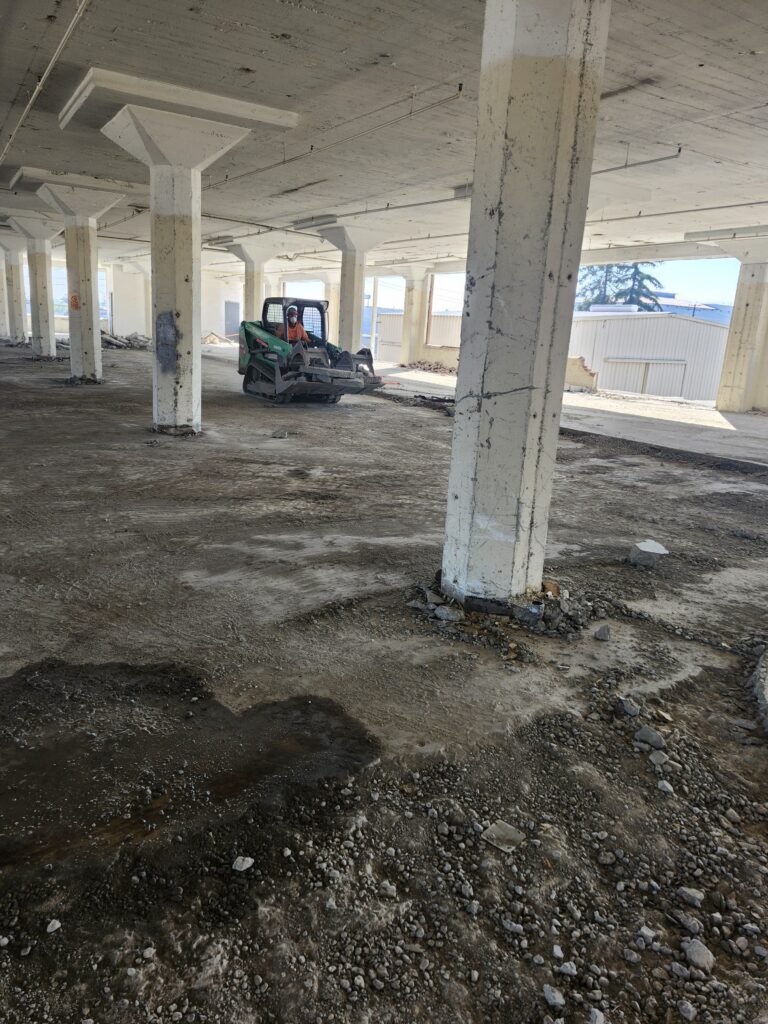

Concerns arose regarding bond reliability of the FRP and localized reduction in flexural and punching shear capacity. Over decades of industrial use, particularly during raisin production, acidic by products and moisture associated with processing operations contributed to progressive deterioration of the concrete floor slabs, especially at the
second-floor elevated slab.
Rather than full slab replacement, deterioration was historically addressed by repeated additions of topping slabs as needed. As a result, while the original structural slab thickness was approximately eight inches, the effective structural slab thickness encountered today varied significantly—ranging from approximately four to eight inches
depending on location and prior repairs.
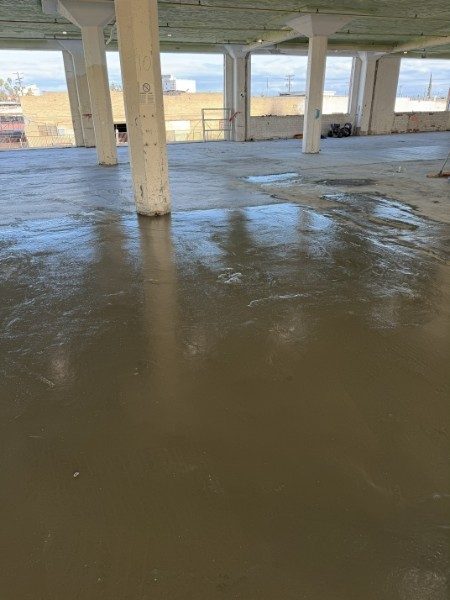
The project team evaluated alternatives but ultimately selected GeoStrong SL, a self-leveling geopolymer mortar from GeoTree, to restore slab profile and capacity. Testing verified flowability and adhesion to the existing concrete. Approximately 78 cubic yards (≈250,000 lbs) of material were pumped onto the second-floor slab, restoring a uniform 8-inch structural profile. GeoTree supplied pumping equipment, on-site technical supervision, and crew training over a two week period. The full slab pour lasted around four weeks.


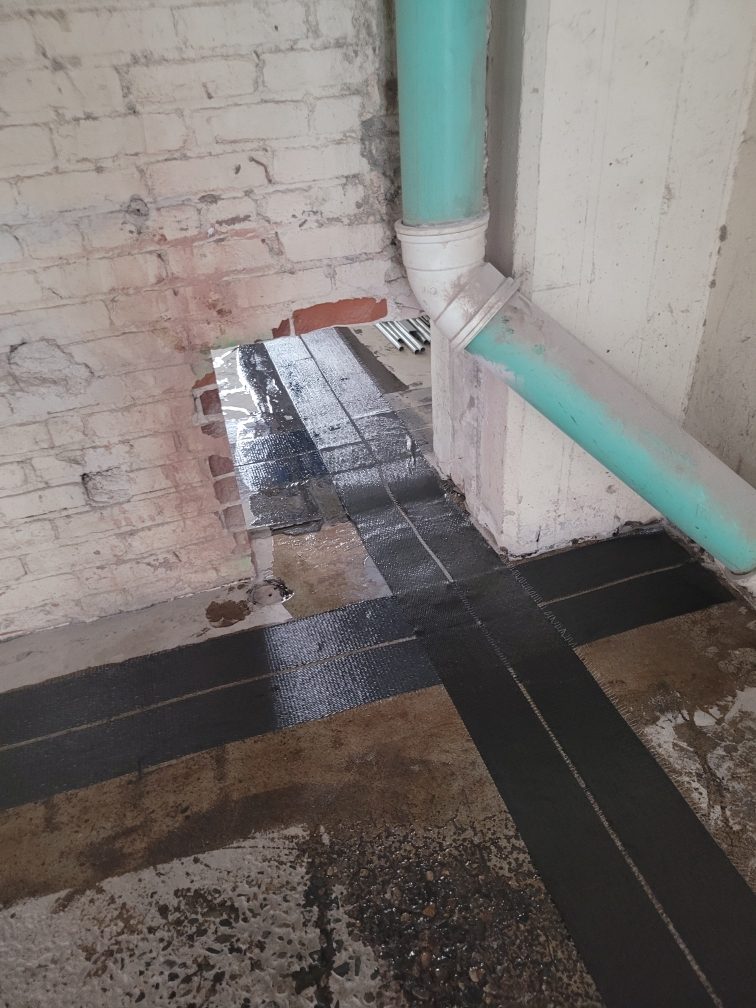
With the slab fully restored, Schwager Davis, Inc., under contract with ARCO/Murray, performed the FRP installation. Following the design and layout provided by GeoTree’s FRP engineers—and formally reviewed and approved by Tipping—approximately 10,000 square feet of CFRP was installed around column regions at the top of the slab to address negative moment demands and complete the strength restoration retrofit. Installation took just six weeks.
NOTES OF INTEREST:
- GeoTree was originally asked to solve just one issue - provide FRP seismic strengthening but as investigations continued, GeoTree also supplied LOCTITE GeoStrong SL to solve another unexpected issue, structural concrete restoration.
- GeoTree helped design the project with the engineer of record from the very beginning to optimize the FRP design and save money for all involved parties.
- Geotree was involved at every step of the project: feasibility, preliminary design, full construction drawings, constructability and installation support.
- GeoTree trainers were on site for two different weeks to deliver vital on-site training to ensure the installation ran smoothly.
- The final installation went flawlessly despite this being the first application of LOCTITE GeoStrong SL being using for a building slab restoration. ARCO/Murray and Heritage Bomanite loved the GeoStrong material and are actively looking for similar applications where we could use it again.