PROJECT OVERVIEW
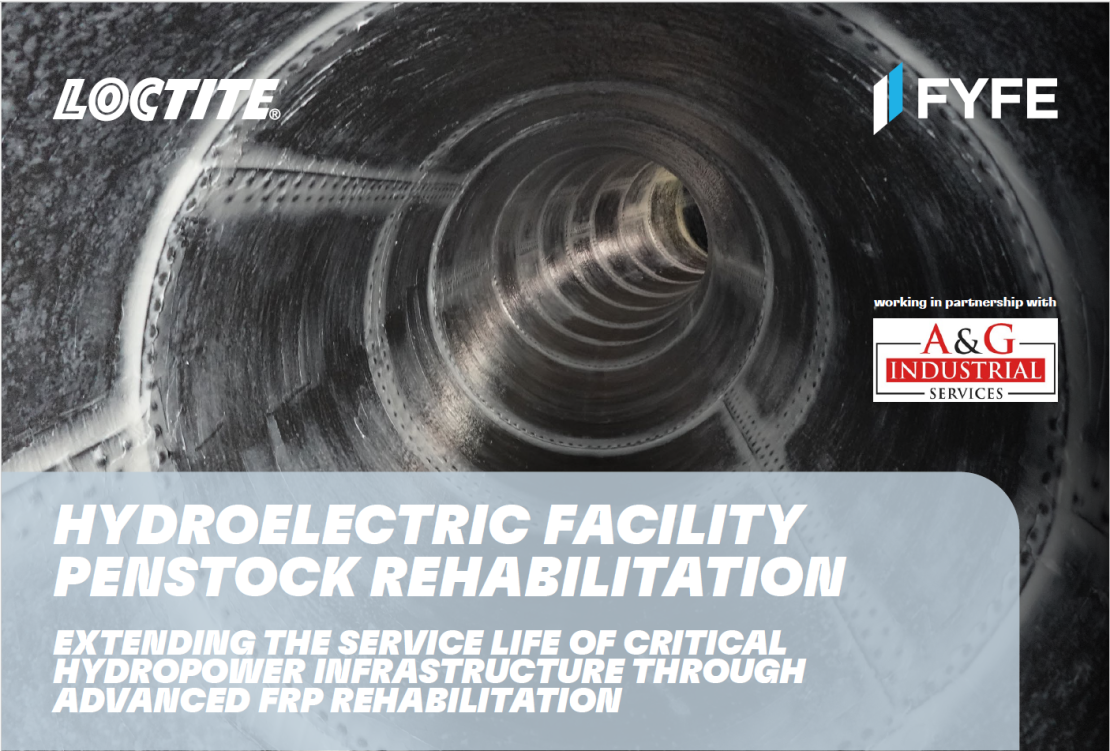
A Hydroelectric Facility, located in Northeast US has been generating renewable electricity since its original commissioning in the 1920s. Central to the facility's operation is an approximately 2,700-foot-long steel penstock system that conveys water from the dam to three turbine units. After decades of service, the ageing infrastructure began exhibiting significant structural deterioration, ultimately resulting in the facility being taken out of service following a 2020 condition assessment.
Fyfe was engaged to develop a long-term rehabilitation solution capable of restoring structural integrity, extending asset life, and enabling the safe return of the penstock system to service without requiring complete replacement of the pipeline.
THE CHALLENGE
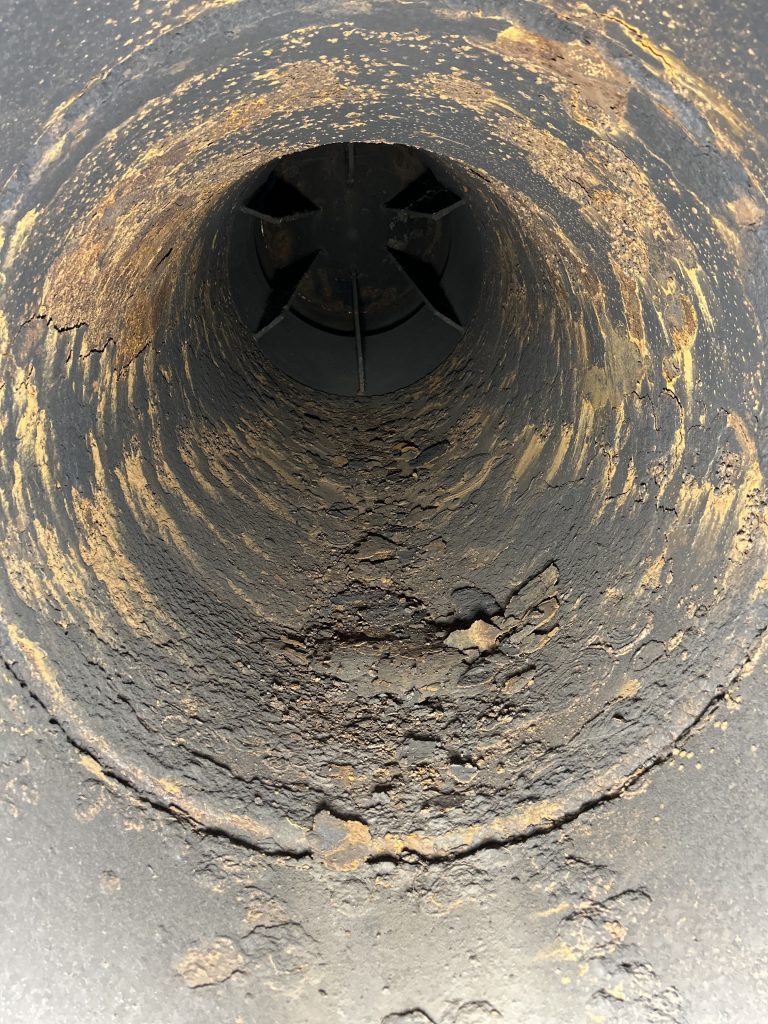
Comprehensive inspections identified multiple forms of deterioration throughout the penstock system. Engineers observed cracking at several saddle support locations, with some cracks extending up to nine inches in length. Thermal stresses had also caused localized buckling and deformation in sections of the exposed steel pipe. Internally, protective coatings had deteriorated, leaving steel surfaces vulnerable to corrosion.
Particular concern was focused on the trifurcation structure, where the main penstock divides into three branch lines feeding the turbines. Ultrasonic thickness testing revealed significant wall loss due to corrosion, with portions of two branch lines falling below minimum acceptable thickness requirements for safe operation.
While initial stabilization efforts included welded steel reinforcement plates, support repairs, and operational modifications to reduce pressure surges, the asset owner required a durable rehabilitation strategy that would provide long-term structural performance while minimizing future maintenance and operational interruptions.
ENGINEERING ASSESSMENT AND REHABILITATION DESIGN
Using information obtained from detailed inspections and evaluations of wall loss, pipe deflection, and ovality, Fyfe developed a full structural Fibre Reinforced Polymer (FRP) liner system based on the principles and limit states contained within AWWA C305.
The rehabilitation strategy utilized a Class IV stand-alone liner design, meaning the FRP system was engineered to independently resist operational and external loads rather than relying on the deteriorated steel substrate for structural capacity. This approach provided a conservative and robust design basis for budgeting, planning, and long-term asset management.
This design basis ensured the rehabilitation system would address both current deterioration and future loading conditions while maintaining structural reliability throughout its service life.
THE REHABILITATION SOLUTION
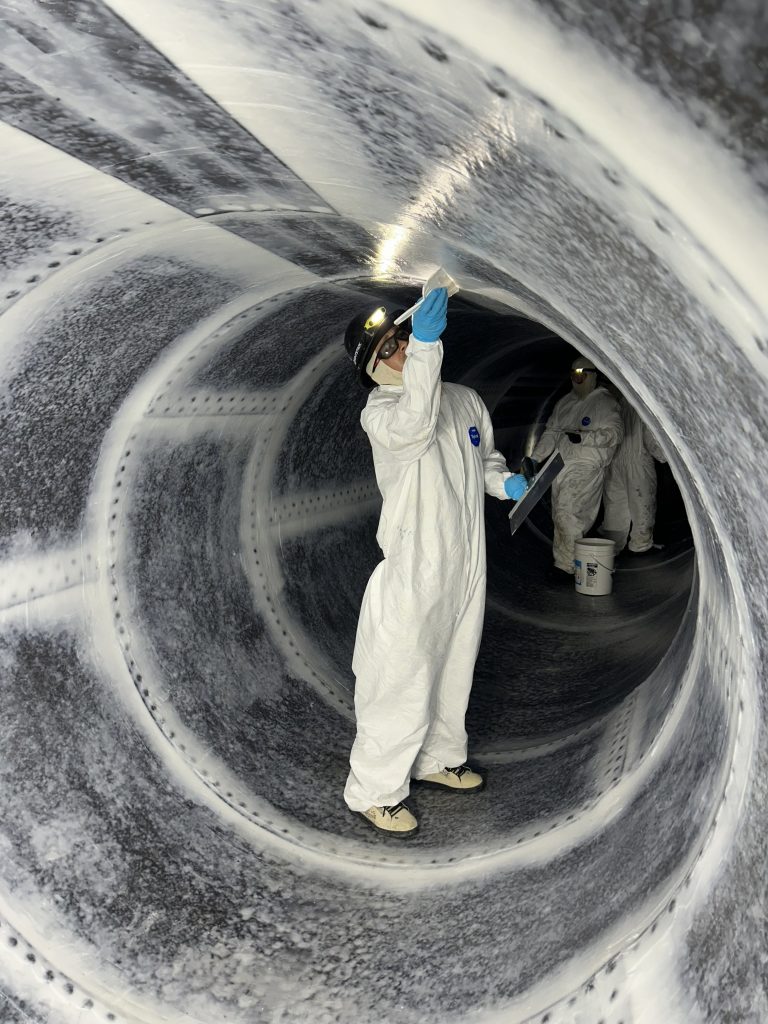
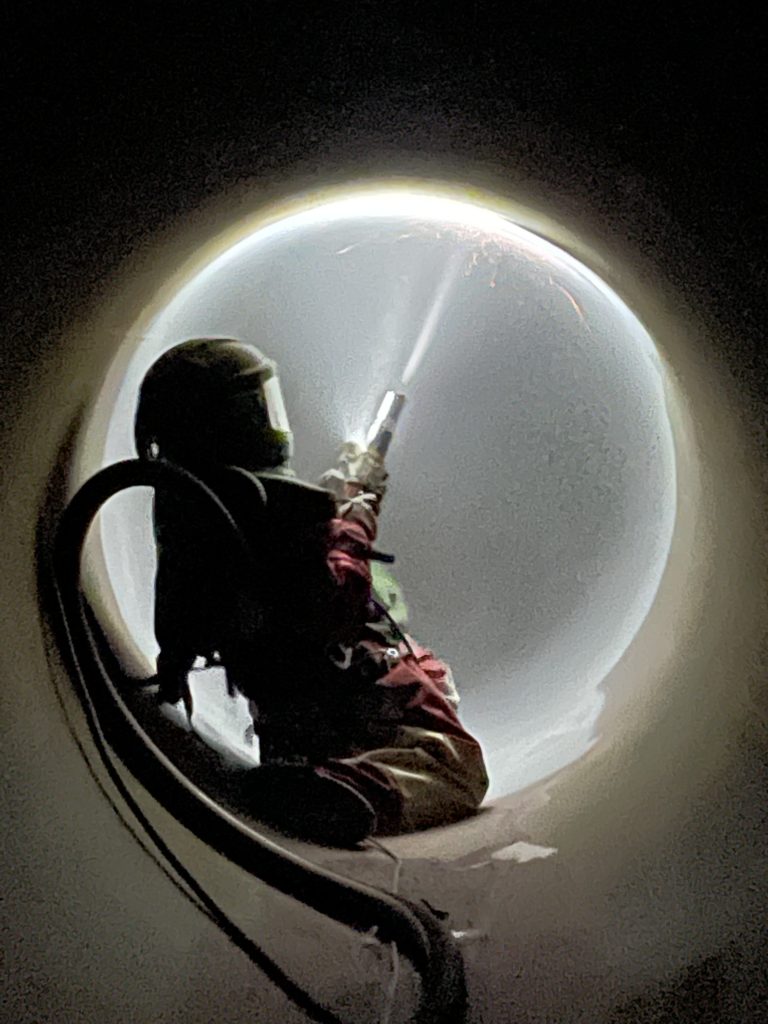
Before any rehabilitation work would could begin, A&G Industrial Services Inc. implemented ultra high-pressure hydro cleaning prior to the grit blasting grit blasting process. Once A & G was finished with the surface preparation process Fyfe was able to start installation of the engineered FRP solution.
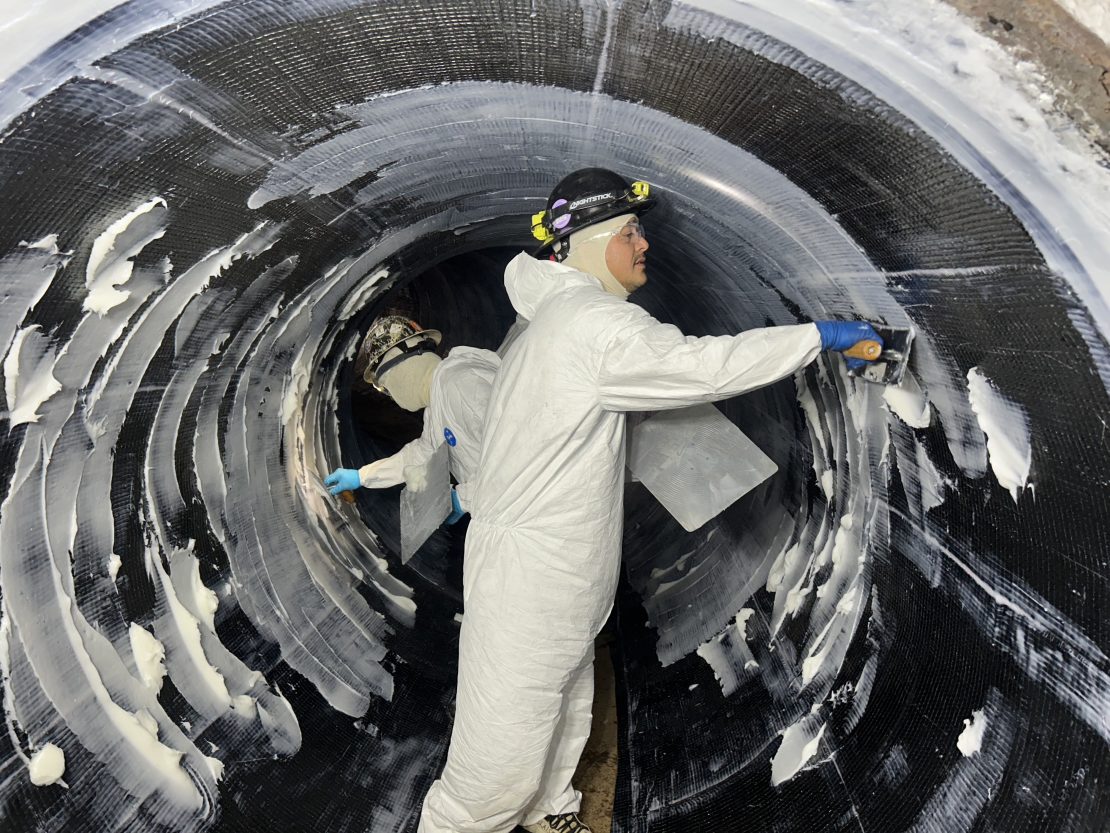
Due to the original rived construction, severe wall lose due to cavitation, corrosion and the many previously installed repairs, the pipe substrate topography was badly in need of repair. The rivet heads and previously installed repairs had to be transitions into the substrate with no more than a four to one ratio so the FRP system could lay flat to the substrate without creating stress risers. This process of re-making the pipe round and flat again was completed via the application of Fyfe's LOCTITE Tyfo S thickened epoxy.
Fyfe designed and supplied a multi-layer LOCTITE Tyfo FRP strengthening system that creates a fully structural internal liner while providing corrosion protection and enhanced hydraulic durability.
The final design consisted of:
One layer of LOCTITE Tyfo WEB GFRP Dielectric Barrier: A glass-fibre dielectric isolation layer was installed directly against the steel substrate. This prevents galvanic interaction between the steel pipe and the carbon fibre reinforcement while improving overall system durability.
Three layers of LOCTITE Tyfo SCH-41-2X CFRP: The structural design incorporated three carbon-fibre reinforcement layers arranged in the following sequence: hoop layer, longitudinal layer and a second hoop layer.
This configuration allows the liner to resist both circumferential stresses generated by internal pressure and longitudinal forces associated with thermal movements, thrust loads, and pipeline restraint conditions.
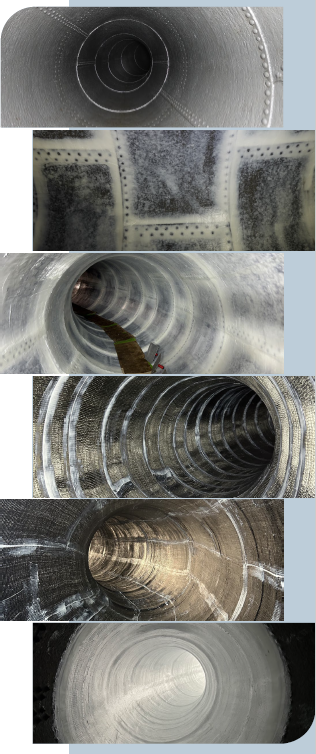
A final protective layer was added: Given the raw water service environment, Fyfe recommended its standard hydraulic protection system comprising: thickened LOCTITE Tyfo S Epoxy finish coat and two coats of LOCTITE Tyfo PWC Epoxy topcoat.
The epoxy system enhances abrasion and scour resistance while providing an additional protective barrier against moisture intrusion and environmental exposure.
All liner terminations incorporated stainless-steel expansion rings. These rings act as additional confinement pressure at the liner ends as a support to the high bonding values of the FRP materials, supporting long-term performance.
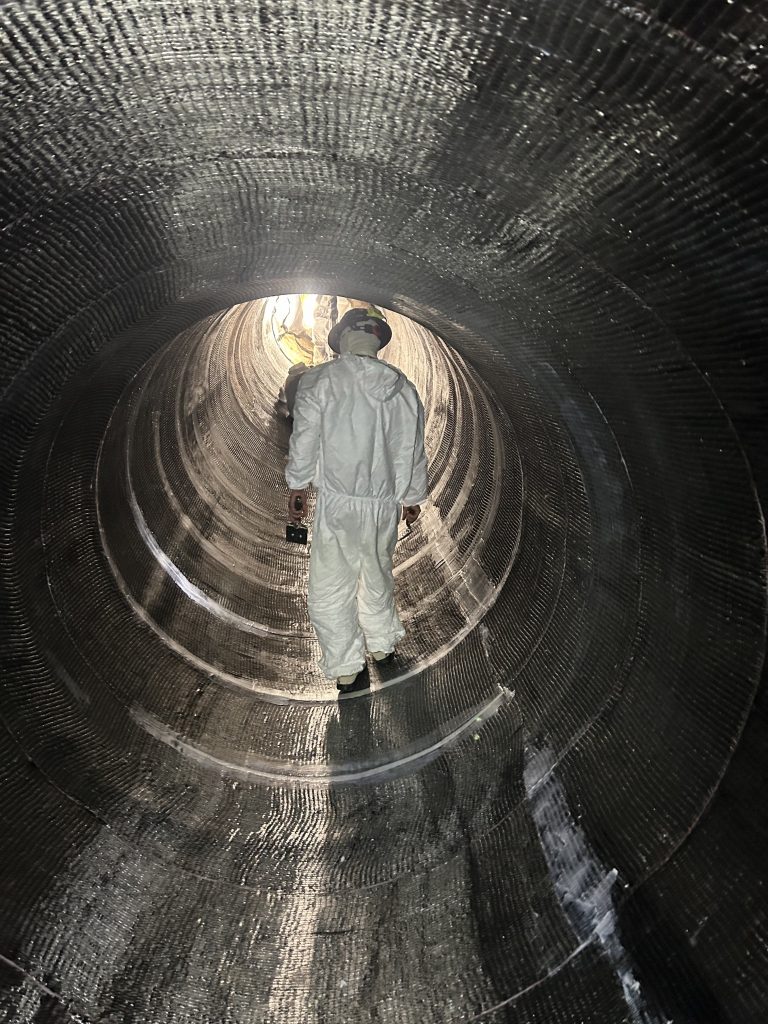
Why FRP and A&G Industrial Services Delivered the Ideal Solution
The rehabilitation method offered significant advantages over conventional steel such as:
- The installation was performed through existing manway access points.
- Minimal disruption to facility operations and surrounding infrastructure.
- Reduced construction duration relative to pipe replacement.
- Elimination of hot works throughout most of the rehabilitation area.
- Ability to rehabilitate the pipeline without extensive excavation.
- Adaptability to confined-space installation conditions.
- A&G Industrial Services delivers decades of rehabilitation experience with highly trained application teams.
The LOCTITE Tyfo resin system also provided important safety benefits during installation. Once mixed and applied, the system produces no volatile organic compound (VOC) emissions, allowing confined-space installation without the respiratory risks commonly associated with other rehabilitation technologies.
PROJECT OUTCOME
The rehabilitation demonstrates how advanced composite technologies can provide a practical alternative to costly pipeline replacement for ageing hydroelectric infrastructure. Building upon detailed condition assessments and targeted structural repairs, Fyfe's pioneering solution supported by AWWA C305 standards was the basis for providing a durable, corrosion-resistant rehabilitation system capable of restoring structural performance and extending asset life for decades.
The project highlights the value of combining engineering analysis, condition-based decision making, proven FRP technologies and highly experiences applicators to preserve critical energy infrastructure. Through this approach, the facility transitioned from a facility facing operational uncertainty to one with a clear pathway for continued safe and reliable operation, ensuring the continued delivery of renewable energy while
maximizing the value of existing assets.