
PROJECT INTRODUCTION
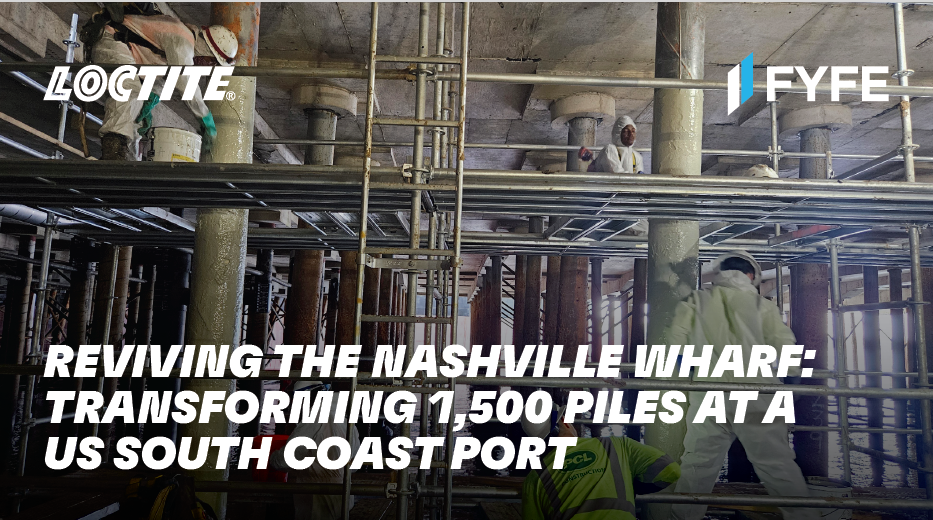
The rehabilitation of the Nashville Wharf at the Port of New Orleans stands as a landmark project in modern waterfront infrastructure renewal. Originally constructed between 1961 and 1962, the wharf extends approximately 22,759 linear feet and has served as a vital component of the port facility facility's operations for decades. Over time, however, the effects of a harsh marine environment began to take their toll, particularly on the structural piles supporting the wharf.
Recognizing the critical importance of maintaining both safety and operational continuity, the Port of New Orleans initiated a major rehabilitation effort involving approximately 1,500 circular concrete-filled steel piles. The project, valued at around $13.5 million, would ultimately become one of the largest fiber-reinforced polymer (FRP) strengthening efforts undertaken in a waterfront environment in North America. PCL Construction, acting as the main contractor and Fyfe's direct client, led
the onsite execution in collaboration with a multidisciplinary team that included Royal Engineers and Consultants, LLC.
WHARF-SUPPORTING PILES DETERIORATION
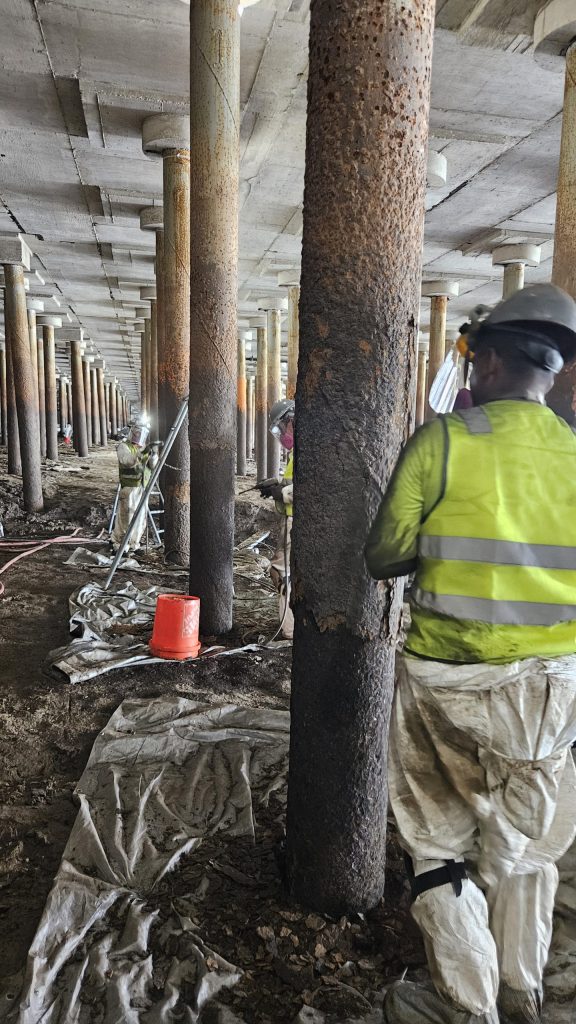
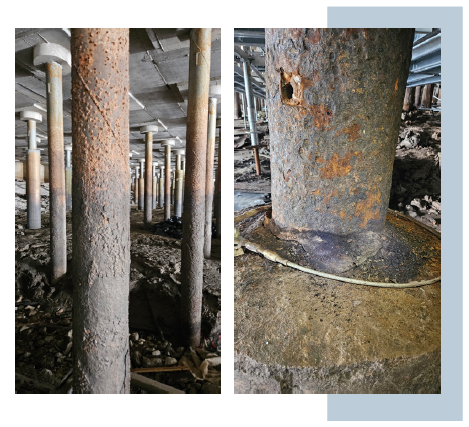
By the time rehabilitation planning began, the wharf’s supporting piles were experiencing significant deterioration. Years of exposure to water, fluctuating tides, and environmental conditions had resulted in severe pitting corrosion along substantial lengths of the steel piles. In many cases, corrosion extended over 13 feet vertically, with pitting depths reaching up to a quarter of an inch. This degradation had progressed to the point where steel loss exposed the internal concrete fill, raising concerns about both structural capacity and long-term performance. Compounding the difficulty, much of the corrosion extended below the mudline, making it harder to access and repair.
Beyond the structural concerns, the port facility faced operational and economic pressures. The Nashville Wharf is a critical asset, supporting ongoing logistics and trade, and could not be taken out of service for an extended period. At the same time, the state had clear ambitions to ensure the facility could continue supporting economic growth well into the future. Previous repair attempts using alternative FRP jacket systems had failed, which heightened the need for a reliable, thoroughly proven solution. The challenge was not simply to repair what was damaged, but to do so in a way that ensured durability, minimized disruption, and avoided the far greater cost of full replacement.
A COMPLEX REHABILITATION PROJECT
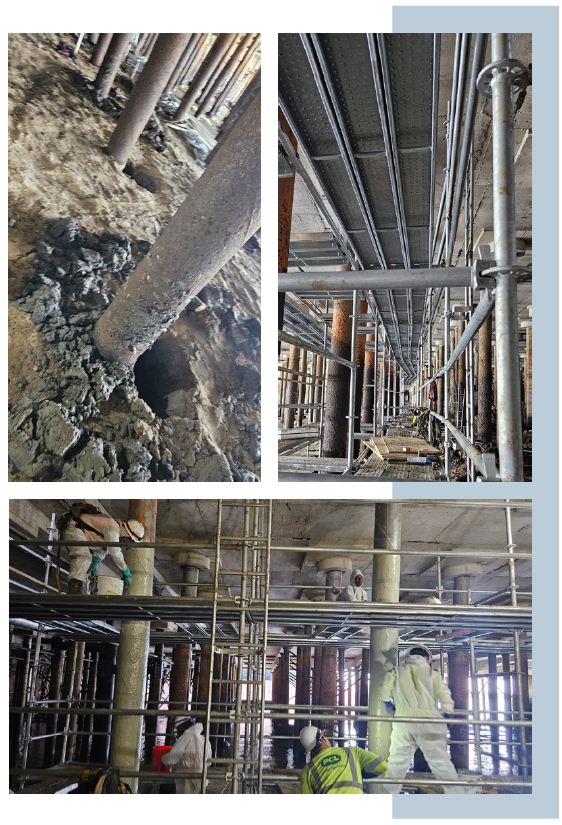
For Fyfe and the project team, the complexity of the environment introduced a combination of technical and logistical challenges. The worksite was defined by its exposure to tidal river conditions, where water levels and currents constantly shifted. Many of the damaged zones were located underwater or beneath the mudline, requiring crews to work in conditions that were both physically demanding and technically restrictive. High humidity, elevated temperatures, and frequent exposure to moisture created additional constraints, particularly when working with materials that typically require controlled conditions to cure properly.
Accessing the piles themselves presented another layer of difficulty. The team had to navigate soft mud conditions that required compaction before work could safely proceed, and in many cases, excavation was needed to reach the footing elevations of the piles. Temporary working platforms, scaffolding systems, and lighting had to be installed throughout the site, all while coordinating material transport in an active port environment. Every step of the process had to be carefully planned to avoid disrupting ongoing operations.
From a technical standpoint, the team faced critical decisions around material performance and installation methodology. The selection of the appropriate epoxy system was particularly important, as traditional systems are not designed to cure effectively in wet or underwater conditions. Maintaining consistent quality across such a large-scale installation also posed a challenge, requiring strict adherence to quality assurance and quality control procedures.
CAREFULLY ENGINEERED SOLUTIONS
To meet these challenges, Fyfe and PCL Construction implemented a carefully engineered solution built around the LOCTITE Tyfo FRP system. A key decision was the use of the LOCTITE Tyfo SW1S epoxy, which is specifically designed to cure even when exposed to water. This capability proved essential given the realities of the marine environment. Combined with LOCTITE Tyfo SCH-41 carbon fiber fabric, the system provided both corrosion protection and structural strengthening.
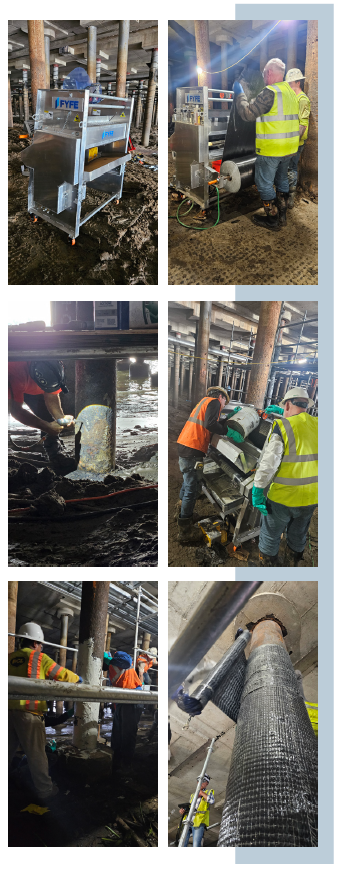
The repair process itself followed a structured, coordinated sequence. Work began with site preparation, including the development of safe access and the stabilization of working surfaces through mud compaction and excavation. Once access was secured, scaffolding, mats, and lighting were installed to enable safe and efficient operations. Materials were staged and transported into position, and saturation equipment was set up to ensure consistent application of the FRP system.
Surface preparation was carried out, ensuring the piles were properly cleaned and ready to receive the repair materials. The team then applied a combination of neat and thickened epoxy before installing the saturated carbon fiber wraps. Each pile received multiple layers, applied to achieve the required structural performance. A final coating was applied to protect the system, and quality control inspections were conducted throughout the process. Verification testing in accordance with ASTM standards provided additional assurance of system performance.
Despite the complexity, the team achieved a steady production rate, completing approximately four fully wrapped piles per day. The work was carefully scheduled to align with the drier months in the US South Coast, maximizing efficiency and minimizing weather-related disruptions.
COMPREHENSIVE SUPPORT CAPABILITIES
Fyfe’s selection for this project was the result of a combination of technical expertise, proven performance, and comprehensive support capabilities. The company brought extensive experience in waterfront rehabilitation, along with proprietary FRP systems designed specifically for challenging environments. Its LOCTITE Tyfo solutions, including hydrophobic epoxy formulations, offered a clear advantage in conditions where moisture could not be avoided.
Equally important was Fyfe’s ability to provide both engineering and field support. This integration allowed for close collaboration with the project team, ensuring that design intent was effectively carried through to installation. The availability of testing data and a strong track record in similar applications gave the client confidence that the system would perform as required.
Compared to conventional rehabilitation methods and competing technologies, Fyfe’s solution offered greater adaptability, reduced disruption to operations, and the ability to extend the service life of the structure by an estimated 50 to 100 years. It also minimized the need for major structural replacement, delivering both technical and economic benefits.
OVERCOMNING CHALLENGING INFRASTRUCTURE ISSUES
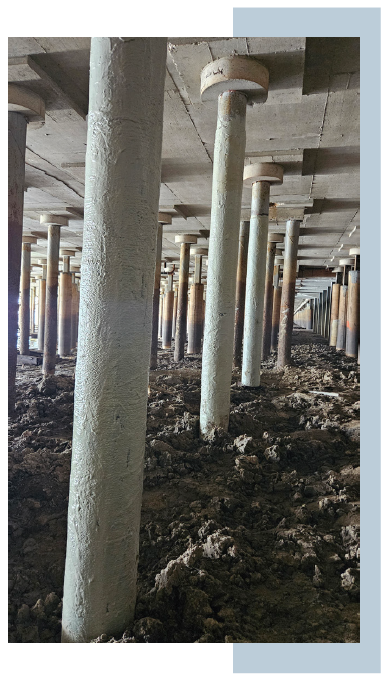
The Nashville Wharf rehabilitation project ultimately demonstrated how advanced materials and collaborative execution can overcome even the most challenging infrastructure problems. By successfully repairing approximately 1,500 piles in an active marine environment, the team preserved a critical asset while ensuring the continued operation of the port facility.
The use of the LOCTITE Tyfo FRP system not only addressed the immediate issues of corrosion and structural degradation but also provided a long-term solution that will support the wharf’s performance for decades to come. The project stands as a testament to the value of combining innovative technology with practical expertise and effective teamwork.
Royal Engineers and Consultants, LLC Construction Manager Christopher Smith said: “Utilizing the LOCTITE Tyfo SCH-41 fabric combined with the LOCTITE Tyfo SW-1S underwater epoxy system on the Substructure Repairs Project proved to be a highly successful solution for both performance and long-term durability. The installation process was efficient, the material quality exceeded expectations, and the system integrated seamlessly with the project requirements.
“The overall outcome helped improve schedule efficiency, minimize future lifecycle costs, and deliver a high-quality finished product to the client. Based on the success of this project, we would confidently recommend the use of this FRP system for similar applications moving forward.”
Want to know more?
Fyfe has supplied fiber reinforced polymer (FRP) systems to simple and complex projects around the world.
Contact us to learn how our engineering team can assist in designing you project to ensure a robust rehabilitation that lasts for decades.